

More
U.S. ADAPTIVE OPEN
Two Tied for Men’s First-Round Lead; Moore Sets Women’s Pace

Two Tied for Men’s First-Round Lead; Moore Sets Women’s Pace
Nearly three years and seven competitive rounds have elapsed since any player not named Kipp Popert has held the men’s overall lead in the U.S. Adaptive Open. For today at least, the three-time defending champion has company at the top.
Justin Carlock, an assistant PGA professional from Eaton, Colo., making his championship debut, shot a 4-under 68 to match Popert in the first round. Two-time and defending champion Kim Moore of Fort Wayne, Ind., sits atop the women’s leaderboard with a 4-over 76.
Carlock, 31, has lived all his life with a condition that caused his fingers and hands to fuse differently, though it didn’t stop him from playing competitively at Northeastern Junior College in Sterling, Colo. He is a newcomer to adaptive golf – in fact, his first adaptive event was the qualifying round in California that gained him entry into this championship.
After the round he talked about his journey and the steps that all competitors have to take to get their impairments confirmed by a WR4GD pass.
“It's absolutely so special for all of us to be here,” said Carlock. “My caddie and best friend, Brock, and I found out about this a few years ago when it was at Sand Creek Station in Kansas. I had played a big college tournament there and thought, how cool is that?
“I wondered if I could get [my disability] certified, and didn’t really do it. This last fall, Brock told me I needed to get in gear. I ended up getting certified and qualified, and here we are.”
The rookie is making the most of his opportunity. He went out in 4-under 32 and recorded six birdies on the day, with his only scorecard blemish coming at No. 17, where he carded a double-bogey 6.
“The whole round was pretty solid,” said Carlock. “Only one bad swing, and that did lead to a double on 17. Had a couple missed opportunities, but better rounds I think are a little bit easier to pick apart. Two more of those, I wouldn't complain no matter how it ends up.”
Meanwhile Popert, who has cerebral palsy, continued his stellar play in this championship by carding one eagle, three birdies and only one bogey on the day. While it wasn’t quite as low as the astounding 11-under 61 he shot in last year’s first round, he wasn’t complaining.
“Let’s be honest, I was really pleased with the round considering last year I obviously just stiffed it the whole time,” said Popert, who also celebrated his 28th birthday today. “I was managing my expectations and trying to not get ahead of myself. Trying to be patient and it worked really well.
“I battled quite well today. Holed a lot of good, nice par putts. I was really pleased with my game and excited for the next two days.”
Both the men’s and women’s leaderboards are bunched at the top, so the championship remains wide open. Popert and Carlock hold a one-stroke edge over 2022 champion Simon Lee of the Republic of Korea and Albert “Chaz” Bowker of Buellton, Calif., each of whom fired 3-under 69. Six other players, including Maryland native Ford Martin, Brendan Lawlor of Ireland and Lachlan Wood of Australia, stand at 1-under 71.
On the women’s side, Moore’s 76 places her one stroke ahead of Cassie Sengul of Manassas, Va., and Sunyoung Kim of Republic of Korea. Bailey Bish, the 2024 champion from Tucson, Ariz., sits three off the pace after a 79.
Moore, a 45-year-old PGA teaching professional who was born without a right foot and a slight case of spina bifida, took home the inaugural U.S. Adaptive Open title in 2022 before winning again at Woodmont last year.
“I feel like I did okay today,” said Moore. “You can’t win it on the first day, but you can definitely lose it, so putting a good score out there the first day is extremely important. I'll take the position I'm in so far, and we'll see how it holds up.”
The second round of the U.S. Adaptive Open will begin at 7:30 a.m. EDT on Tuesday, July 7. Due to expected late-afternoon thunderstorms, the field will again play in foursomes off the 1st and 10th tees. Following completion of play on Tuesday, a cut will be made to include the following players for the final round on Wednesday, July 8:
Top 20 overall men and ties
Top 10 overall women and ties
Top 3 men and ties from each impairment category
Two 2 women and ties from each impairment category
Any player within 5 strokes of the lead in their impairment category
Notable
Local players Jack Bonifant of Silver Spring, Md., and Cassie Sengul of Manassas, Va., had the honor of hitting the first shots of the championship from the first and 10th holes, respectively. Bonifant, 36, suffered a fractured skull as an infant and lost feeling on the left side of his body. has a coordination impairment. Sengul, 20, who has cerebral palsy, plays on the golf team at Drew University in Madison, N.J.
Fifteen years ago, Michael Nicholson, of Tampa, Fla., lost both of his legs and his left arm in an explosion in Afghanistan while serving as a sergeant in the U.S. Marine Corps. This week is the first time that Nicholson has returned to the Washington, D.C., area since he spent nearly two years recovering from his injuries at Walter Reed Medical Center, just five miles from Woodmont Country Club. He is competing this week in the Seated Player category.
There are five sets of tees in use on the South Course at Woodmont – up from four last year, in an effort to match the length of the course to the needs of the players in each of the eight impairment categories. The total course length ranges from the Blue tees at 6,421 yards to the Yellow tees at 3,575 yards.
Three-time defending Seated Player category champion winner Max Togisala of South Ogden, Utah, shot a 1-over 73, continuing his strong performance in the U.S. Adaptive Open. Brock Leitner of Canada is three strokes behind with a 4-over 76.
Ryanne Jackson of Seminole, Fla., the 2023 women’s overall champion, stands in third place in the Coordination Impairment category after an 82. Jackson, 28, was an accomplished high school basketball player and golfer before being diagnosed with muscular dystrophy as a college freshman. She is a certified EMT in St. Petersburg, Fla.
Quotable
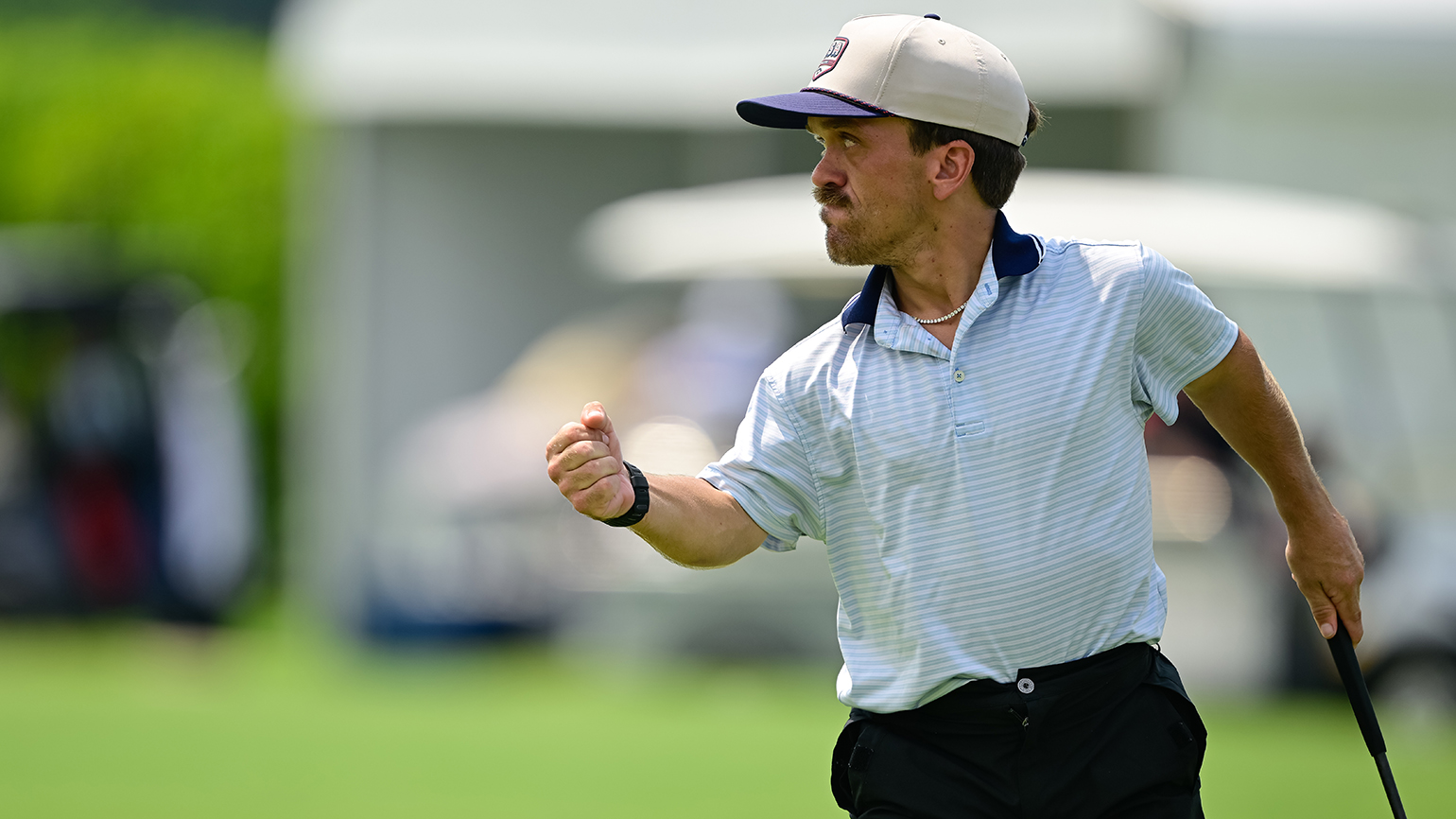
“Definitely the experience and being able to play with all the guys and content creators that I get to play with nowadays, they have great games and we have good matches. So I kind of took that mindset to the golf course today, and just gave it my all. Because I knew I could do it and I did.” – Chaz Bowker (Short Stature), 29, Buellton, Calif.
“It's incredible to see so many familiar faces and all the new faces as well. It really shows that adaptive golf is growing. To see all these women that are coming for the first time to this event is great and it shows that women adaptive golfers are really be recognized and competing at high levels now.” – Bailey Bish (Coordination Impairment), 26, Tucson, Ariz.
“Yeah, I would say the first six holes are the easiest on the course, so just took advantage. I had a chip-in birdie on No. 1, so that is always good to start. And then the two par fives are always good to birdie. So that was nice.” – Mario Dino (Coordination Impairment), 23, Denver, Colo.
“Yeah, I played with a lot more confidence. I know that was my big thing, just being confident with what I have. So I really just try to throw it all out there and trust myself, and I could really see that on some of those holes. Really just giving myself the opportunities to score out there was the main difference compared to previous years in this championship.” – Cassie Sengul (Coordination Impairment), 20, Manassas, Va.
© 2026 United States Golf Association. All Rights Reserved.