

More
U.S. ADAPTIVE OPEN
Popert, Moore in Position for Encore Victories at Woodmont

Popert, Moore in Position for Encore Victories at Woodmont
Stop us if you’ve heard this one before: Kipp Popert shoots an under-par round to strengthen his grip on another U.S. Adaptive Open title. The 28-year-old, three-time defending champion from England fired a bogey-free 67 for a 36-hole total of 9-under-par 135, three strokes clear of first-round co-leader Justin Carlock.
Carlock, a newcomer to adaptive golf, carded a 2-under 70 to go along with his first-round 68, good for a 6-under 138 total. Simon Lee, the champion of the inaugural U.S. Adaptive Open in 2022, sits one stroke behind Carlock at 5-under 139.
In his quest to become the first male in history to win the same USGA championship four years in a row, Popert, who was born with cerebral palsy, has only made one bogey through 36 holes. So if any of the challengers hope to challenge him on Wednesday, they will have to bring their best stuff.
“I’m really pleased with how I’ve played the last couple days and really pleased with how composed I’ve been at times,” said Popert.
He is also not lacking for motivation.
“This is our major. I don't think I need to explain that. Anyone who knows me knows this is why I've practiced and played my whole life.”
Another familiar face leads the women’s side of the draw, as two-time and defending champion Kim Moore of Fort Wayne, Ind., shot a second straight 76. Moore holds a one-stroke lead over Sunyoung Kim of the Republic of Korea.
The 26-year-old Kim, playing in her second U.S. Adaptive Open, finished in 7th place in this championship last year at Woodmont and won the Intellectual Impairment category. Tied for third, two strokes behind Kim, are 2024 champion Bailey Bish, 26, of Tucson, Ariz., and 20-year-old Cassie Sengul of Manassas, Va., who finished in fourth place behind Moore last year.
Like Popert, Moore knows how to keep her poise when a championship title is on the line. The 45-year-old PGA teaching professional has become known for her steady approach under pressure.
“That experience is going to be huge for me,” said Moore. “I always like playing with my competition. I know what I have to do. I just need to keep doing the same thing, hitting the fairways, hitting the greens, trying to make putts when I can and trying to limit big numbers. If I can do that, I think I’ll do very well.”
While Carlock, who was born with a condition that caused his fingers and hands to fuse differently, wasn’t quite as sharp today, he still recorded his second straight under-par round to give himself a chance to chase down Popert.
“To be in the mix with Kipp and all these guys right now, I’m thrilled,” said Carlock. “That's a beautiful trophy. I want it bad.”
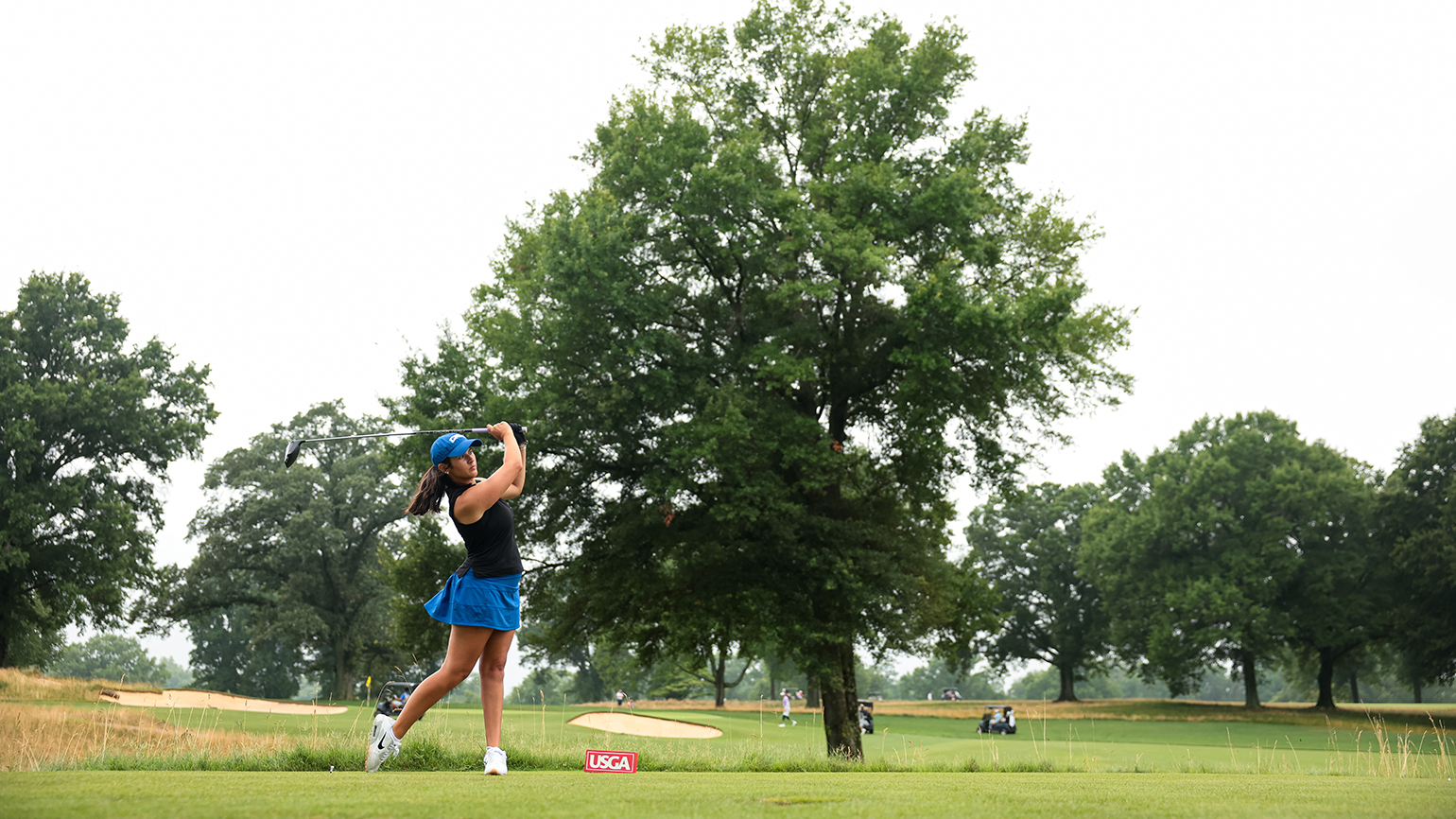
Matching Popert for the round of the day and the championship was seated player Max Togisala, 22, of Ogden, Utah. Togisala also had a bogey-free 67 – matching his best score from last year’s championship at Woodmont – and sits in a tie for fourth place at 4-under-par 140 with Lachlan Wood of Australia.
“As a seated golfer, I feel like we don’t get the credit for some of the scores that we put up,” said Togisala. “Hopefully what I’m doing this week and previous years has shown that we’re able to compete against everyone else.”
Following the completion of today’s second round, a cut was made to the top 20 overall men and ties, top 10 overall women and ties and any player within 5 strokes of the lead in their impairment category. A total of 45 players – 30 men, 15 women – will return for the final round on Wednesday, July 8. Tee times begin at 7:49 a.m. ET in groups of two off the first tee. The conclusion of the championship will be broadcast live on Golf Channel from 1 to 4 p.m. ET.
Notable
Four players in the field – Amanda Cunha, Russell Aide, Tyler Cashman and Sophia Howard – are part of the adaptive golf team at the University of Arizona. Cunha, 22, paved the way for the creation of the team when she was a senior in high school and learned about the university’s Disability Resource Center. There were other adaptive sports teams but not golf, and she worked with the athletics department to create one.
Annie Hayes, the only female seated player in the field, had a memorable eagle on the par-5 3rd hole in the second round. After leaving herself just off the green in two shots, she used a 9-iron from a sidehill lie that hit just off the green and rolled in for her first-ever eagle.
There has never been an American male champion of the U.S. Adaptive Open. Carlock, Togisala, Chaz Bowker (Buellton, Calif.) and Ford Martin (Potomac, Md.) are all currently in the top 10.
Togisala’s second-round 67 was the first-ever bogey-free round by a seated player in U.S. Adaptive Open history.
Quotable
“This is the greatest traveling circus on the planet, this adaptive golf. To be at such an amazing facility and the way you guys at the USGA put it on for us, it's one of the most memorable weeks of the year every single year for sure. It's a family that I love and respect so many people that are here.” – Jordan Thomas (Multiple Limb Amputee), 37, Nashville, Tenn.
“You can be very respectable as a seated player. You don't have to give it up. The way the USGA sets up the rules, they make it so that you can play the game in a fair way even when you're playing from a cart. There are a lot of exceptions that they have to make for us because our cart is so big.” – Annie Hayes (Seated Players), 63, Lee, Mass.
“I looked at the scoreboard. Josh Kelley (my caddie) said, Chaz, we need this one on 18. I just thought about it, if the ball is short and doesn’t go in, story of my life. I made sure to get the ball to the hole, and it dropped.” – Chaz Bowker (Short Stature), 29, Buellton, Calif.
“For visually impaired players, the more you play a course, the better it is and the more comfortable you are. So having played it last year as well and four times so far this year, the course feels a little bit more gettable this year because it's also softer. I feel like I've just got to go out and keep doing what I'm doing.” – Kiefer Jones (Vision Impairment), 36, Canada
“I've always had the mindset of there's always more golf. I never stray away from buckling down on the next day and playing better. I really enjoy being able to kind of prove to myself and show myself that I can shoot those low rounds.” – Amanda Cunha (Vision Impairment), 22, Kaneohe, Hawaii
© 2026 United States Golf Association. All Rights Reserved.