

More
U.S. NATIONAL DEVELOPMENT PROGRAM
U.S. National Junior Team Defeats Team Sweden in International Match at Vaquero Club

U.S. National Junior Team Defeats Team Sweden in International Match at Vaquero Club
Results
For the third consecutive year, the U.S. National Junior Team hosted an international opponent for a two-day World Amateur Golf Ranking ®-sanctioned match, this time defeating Team Sweden 15.5-8.5 at the Vaquero Club outside of Dallas. The two-day competition featured mixed foursomes, mixed four-balls and singles sessions with each of the squads represented by six girls and six boys.
For many involved, the week was about more than competition. It was an opportunity to learn how the top junior golf programs in the world train and develop their players. On the eve of the two-day competition, both teams participated in a joint practice session. The first segment was run by Team Sweden, featuring a unique sequence of drills and mini-competitions focused on gamifying practice, simulating social and competitive pressure, and preparing players to adapt to the unpredictable nature of competition.
The second session, run by the U.S. National Development Program, focused on analytics and calibrating yardages.
“Our approach to practice is to simulate what happens out on the golf course as much as possible,” said Sweden Head Coach Ola Lindgren. “It’s so easy to just stand there beating balls, but the more you can take advantage of each other’s games, you actually start competing in practice. During our joint practice, we added a lot of social pressure, which is what happens in tournament play. As much as you can simulate tournament play, that’s what we want to do in practice.”
On Friday, the 12 juniors from each team began the first day of competition, consisting of six mixed (boys and girls) foursomes matches in the morning, followed by six mixed four-ball matches in the afternoon. In recent Ryder/Solheim Cups, the United States players have been criticized for struggles in alternate-shot, foursome matches. However, those same woes were not present for the U.S. National Junior Team, which won five of the six foursomes matches in the morning.
After losing the 17th hole to a birdie from Team Sweden, Ronin Banerjee and Jude Lee secured a point for the United States with their par on the 18th, winning their match, 1 up.
"Foursomes was probably the most challenging because of the way the wind was blowing and how hard it was for us to get into a rhythm,” said 17-year-old Banerjee, a Southern Californian who went 3-0-0 and has verbally committed to the University of Tennessee. “We just made good swings at the right times. She made some clutch putts, and then I made some good swings, and we made it happen.”
Facing a 5-1 deficit, Sweden responded in the afternoon, winning four of the six four-ball matches, closing the day trailing 7-5. Each of Sweden’s wins came down to the 18th hole, including the match of the afternoon between the United States’ Tyler Watts/Amelie Zalsman and Sweden’s Benjamin Hård/Molly Ralin. After Sweden built a 2-up lead with three holes to play, the United States won the next two, highlighted by a 20-foot birdie putt from No.19-ranked amateur Watts on the par-4 17th. After seeing their two-hole lead vanish and her partner’s wayward tee shot on the 18th, Sweden’s Ralin calmly sank a 15-foot birdie putt to win the match, securing the team’s second point of the competition.
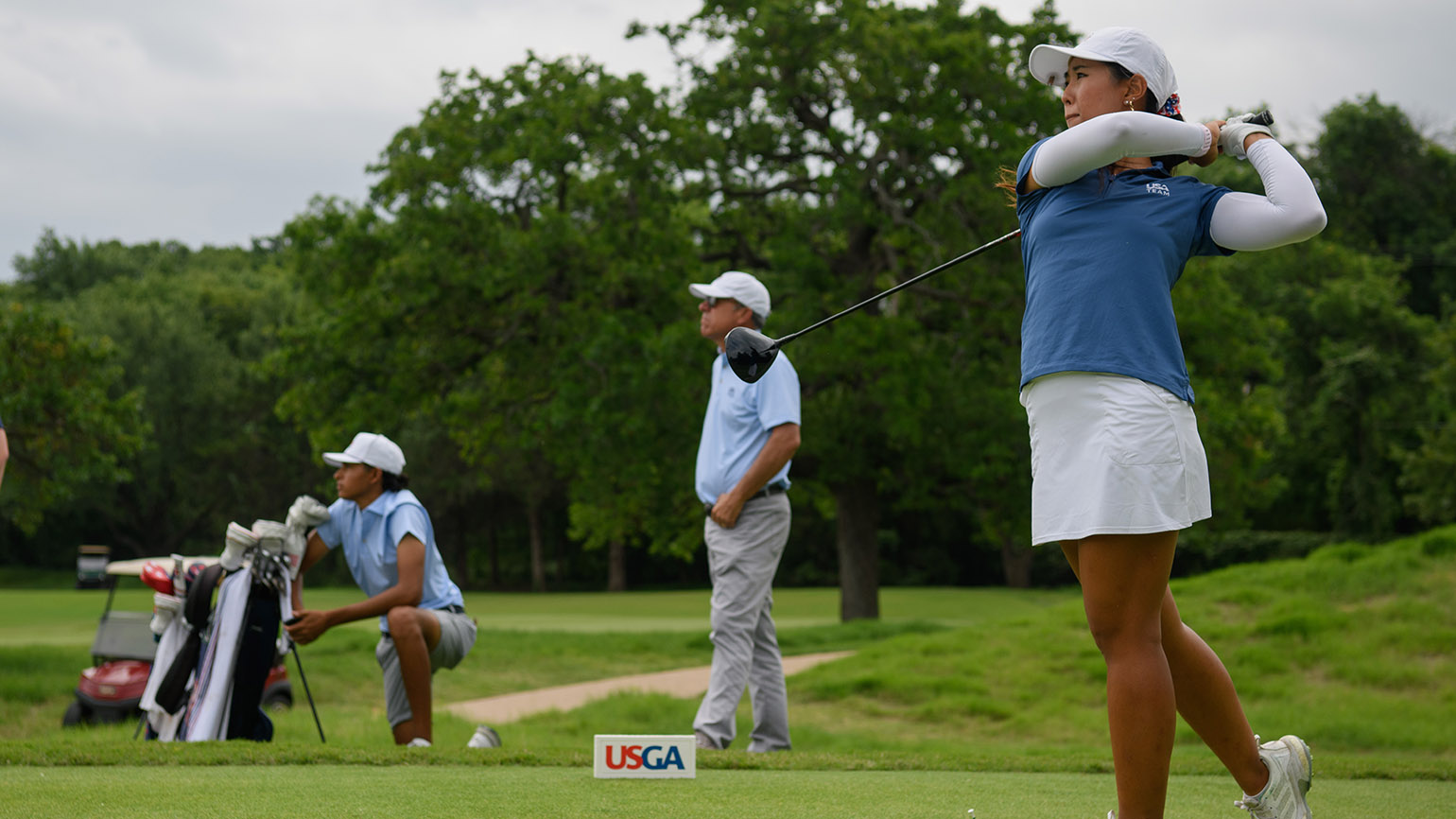
“He was still able to make par, so that made me more relaxed and calm,” said Ralin, who represented Europe in the 2024 Junior Solheim Cup in Virginia. “It felt better to have him by my side today. We made a lot of birdies, and we complemented each other pretty [well] today.”
Following a morning delay due to rain and lightning, players donned beanies and long sleeves during Saturday’s 12 singles matches. Jude Lee, of Walnut Creek, Calif. – the other player to go 3-0-0 in matches this week – faced off against Sweden’s Ebba Mejer. After dropping her first two holes, Lee, who has signed to play at Stanford University in the fall, went on a commanding run, winning seven of the next 12 holes on her way to a 5-and-4 victory.
“I think I was in a good headspace all week,” said Lee. “No matter what happened, I just believed that if I just stuck to one shot at a time, things would work out. I think I just stuck to my process really well. I think having the mindset of gratitude and enjoying every moment really helped throughout the two days of competition.”
Carl-Hugo Eriksson, of Sweden, secured one of his team’s 3.5 points on Saturday by defeating Jaden Soong, of Burbank, Calif., 3 and 2. After building a 2-up lead during the front nine, Eriksson birdied the par-4 15th before sticking his approach on the 16th to 10 feet, making the putt and closing out the match.
“I think I did well with not missing as much,” said the 18-year-old Erikson. “I think the U.S. players are so good. So, I’m trying to replicate what they are doing and implement it in my own game.”
Aside from players improving their competitive skills and coaches refining their processes, the experience at Vaquero has inspired a fundamental change to the approach of the USNDP as a whole. In reflecting on the victory over Team Sweden, USNDP assistant coach Tiffany Joh was marveled by Sweden’s approach to the development system at large.
“Sweden has been doing this for probably the longest out of anyone,” added Joh. “Just getting to interact with their support staff and their coaches, getting some insight into … why they do what they do. It's been really cool. Their whole system is focused on looking at the golfer more holistically and that’s something we want to do more of moving forward.”
Griffin Genobaga is a coordinator of championship communications at the USGA. Email him at genobaga@usga.org.


© 2026 United States Golf Association. All Rights Reserved.