
More
U.S. WOMEN'S AMATEUR
Tennessee Titan: The Honors Course Thrives in Commitment to Amateur Golf

Tennessee Titan: The Honors Course Thrives in Commitment to Amateur Golf
This content was first published in Golf Journal, a quarterly print and monthly digital publication exclusively for USGA Members. To be among the first to receive Golf Journal and to learn how you can help make golf more open for all, become a USGA Member today.
When five Chattanooga, Tenn., business leaders met in October 1980, none could have imagined the partnership formed that day would create a golf course whose legacy continues to grow more than four decades later. Since its 1983 opening, The Honors Course has remained true to its founding principle, espoused by the man who called that meeting, Jack Lupton: to celebrate amateur golf. That ethos will be on display again from Aug. 4-9 when the club holds the 126th U.S. Women’s Amateur, its seventh USGA championship.
Lupton, who died in 2010, once owned and later sold the world’s largest Coca-Cola bottling company. He didn’t start playing golf until his mid-20s but soon became friends with Bob Jones and, eventually, an Augusta National member himself, embracing the game and the camaraderie it generates.
“He always said he loved those scenes where you have the players with the gallery following them down the fairways,” said Joel Richardson Jr., Lupton’s attorney, who attended that initial meeting. “Jack was a visionary. He picked the name of the club and said that its mission would always be to honor amateur golf.”
Mission accomplished. The club’s logo evokes the trophy given to the champion of the Tennessee Amateur, and there is an Honors Circle in front of the modest clubhouse with 17 bronze plaques that recognize golfers who have won notable events there.
The site chosen for what would become The Honors Course is a short drive northeast of Chattanooga in Ooltewah, next to White Oak Mountain on heavily wooded property that housed a munitions plant during World War II. “Jack said there’s only one person that’s going to build my golf course, and that’s Pete Dye,” recalled Richardson, who has served as the club’s chairman since 2001, when Lupton suffered a stroke.
Richardson explained that Dye visited the site and reported back to Lupton later the same day. “Pete said, ‘There are 14 natural green sites. I think you can build a golf course on that property.’”
Dye, along with his son P.B. Dye, authored a mix of parkland and more open holes, resulting in a layout of greater visual subtlety than many of his other high-profile courses.
“That was largely Mr. Lupton’s influence,” said David Stone, superintendent at The Honors Course from opening day until his retirement in 2016. “He didn’t want a lot of railroad ties. He wanted to make it playable, certainly, and didn’t want it to get too severe. But it’s still a very tough course, there’s no doubt about it, particularly on and around the greens. The fairways are reasonably wide, but when you miss shots you get penalized.”
Henrik Simonsen, director of golf since 2007, agrees. “I can’t think of a better match-play golf course. So much risk-reward, which is typical Pete Dye. It hits you right away with the second hole, a challenging par 5 of which Dye said, ‘No one should ever go for this green in two.’ And there’s no water on it!”
Richardson remembered that Lupton, who served on the USGA’s Executive Committee in 1983, was interested in hosting amateur tournaments on The Honors Course. “He had invited (then-USGA executive director) P.J. Boatwright Jr. to see the golf course after it opened and Jack asked him, ‘Do you think we have a course that would be capable of hosting USGA amateur championships?’ Boatwright told him, ‘I think you’d be able to host any USGA event you wanted to on this course.’”
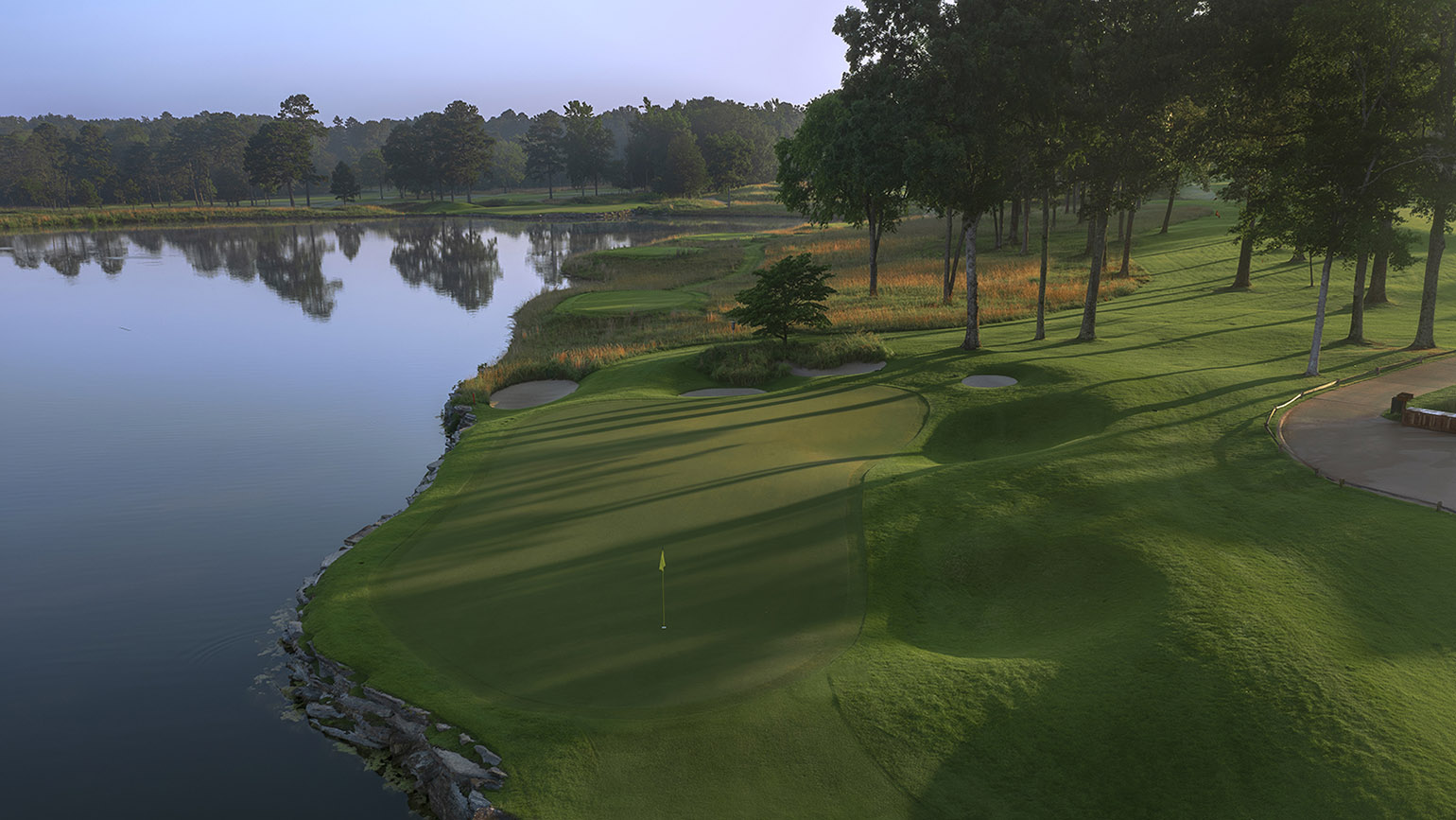
The U.S. Women’s Amateur is the latest chapter in the club’s long relationship with the USGA, which began with the 1991 U.S. Amateur, won by Mitch Voges over Manny Zerman, 7 and 6, in the 36-hole final. In 1994, The Honors Course hosted the Curtis Cup Match, which ended in just the third tie in that competition’s history. Kevin Marsh recorded the largest-ever margin of victory in a U.S. Mid-Amateur, defeating Carlton Forrester, 10 and 9, in 2005. Terri Frohnmayer captured the U.S. Senior Women’s Amateur in 2011, and five years later, in the U.S. Junior Amateur, Min Woo Lee beat Noah Goodwin. Most recently, Louis Brown won the 2024 U.S. Senior Amateur, and the U.S. Amateur is scheduled to return in 2031.
Another chapter in the club’s rich history was written in 1996 when it hosted the NCAA Men’s Division I Golf Championship. Tiger Woods, representing Stanford University, won the individual title by four strokes despite shooting a final-round 80, which included a triple bogey on the ninth hole.
“He always said that it’s a hard golf course,” Richardson noted. “But I would say it’s a fair one, too. I talked with an architect who worked with Pete Dye from time to time, and he said we got Pete at his best because of the greens and their undulations. They are difficult greens but also some of the best you’ll ever see.”
The club takes amateur golf so seriously that while it has two current PGA Tour pros as members – Chattanooga native Keith Mitchell and Harris English, who both attended the Baylor School in the city – they were only accepted because they joined prior to turning professional.
“It instantly became one of my favorite places that I’ve ever played,” said English. “It’s got a strong finish with 16, a par 3 over the water; 17 is an awesome par 5, kind of an S-shaped hole going up the hill; and 18 is a great finishing par 4. It’s such a special place.”
A major course restoration project led by Gil Hanse started in October 2021 and was completed in 10 months. Says Simonsen: “When we reached out, [Gil] said, ‘I’ll do it – on two conditions. Number one, I get the consent of Pete Dye’s family.’ He also said, ‘Don’t ask me to turn one of Pete’s best courses into a Gil Hanse course. I just want to enhance what’s here and make it a little bit more relevant to the game today.’ It’s still very much a Pete Dye course.”
Regarding this summer’s U.S. Women’s Amateur, Simonsen foresees a particular type of player who is likely to earn the Robert Cox Trophy, presented to the winner since 1896, making it the oldest original USGA trophy.
“The player who tries to conquer this golf course is going to fail,” he said. “The player who is patient and puts the ball in play on every single hole and just kind of wears out the opponent will have an advantage. The rough will play very penal, so if you try to bomb it and miss the fairway, you might not be able to advance the ball to the green. If I was caddieing, I would tell my player to play conservatively, play for par. The greens are only four years old since the restoration, so we’re still able to make them very firm and fast.”
A bit of a running joke – although maybe not so funny to first-time visitors – is that finding the club’s unmarked entrance may be just as hard as breaking par here. The former won’t be an issue during the U.S. Women’s Amateur, when appropriate signage will be in place. In any case, the club’s devotion to amateur golf is no laughing matter.
“It’s the darnedest thing,” said Simonsen. “I’ve been here a long time, and obviously I’ve bought into and understand the concept of honoring amateur golf. But it’s everything to this club, and our members are proud of that legacy. It’s who we are.”
Tom Mackin is a Scottsdale, Ariz.-based freelance writer who contributes frequently to Golf Journal.
© 2026 United States Golf Association. All Rights Reserved.